We now have a comment system in the blog, using giscus. Take a look in any blog post view, like this one, and there it will be.
The comments are stored as Discussions in the Github repository for this web.
We now have a comment system in the blog, using giscus. Take a look in any blog post view, like this one, and there it will be.
The comments are stored as Discussions in the Github repository for this web.
The academic paper “Hearts, Clubs, Diamonds, Spades: Players Who Suit MUDs” was written by Richard Bartle. Published in 1996, it is a seminal work in the field of game studies and player psychology. In this paper, Bartle categorizes players of Multi-User Dungeons (MUDs) into four distinct types based on their preferred activities and motivations within the game.
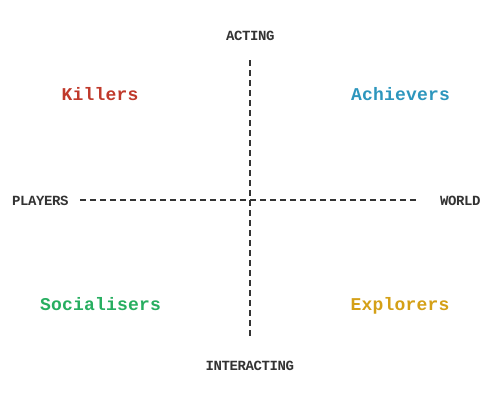
Recreation of the classic Bartle’s player types diagram from the original 1996 paper.
What makes Bartle’s taxonomy genuinely interesting is not just the classification itself, but the dynamics between player types. Bartle observed that increasing certain player types in a MUD directly affects the population of others. For instance, too many Killers will drive away Socialisers, which in turn reduces the supply of victims and eventually drives away the Killers themselves. A healthy MUD needs a balance of all four types.
This insight remains relevant for any online multiplayer game, even those far removed from text-based MUDs. Anyone who has seen a game community collapse under the weight of toxic PvP or watched an MMO server die after the social players left has witnessed Bartle’s dynamics in action.
At Maldorne, we have been building multiplayer games with the Hexagon mudlib for years. Whether we are designing combat systems, crafting economies, or planning social spaces, Bartle’s framework helps us ask the right questions: which player types does this feature serve? Are we accidentally pushing a type away?
For example, the weather and climate systems in our games affect exploration and survival, giving Explorers and Achievers something to engage with. The towns, guilds, and public spaces are designed with Socialisers in mind. And combat provides the competitive edge that Killers seek.
Understanding these dynamics is also crucial when playtesting — observing which player type your testers gravitate towards tells you a lot about what your game is actually offering versus what you intended.
If you are interested in more MUD-related resources, we maintain a curated list in our awesome-muds repository.
Read it online, it is really worth it. At roughly 20 pages, it is an accessible and well-written read even if you have never played a MUD. The concepts apply to any multiplayer game.
For some time now, we have been maintaining the GitHub repository awesome-muds, which contains a large list of resources, articles, technologies, etc., related to the world of MUDs. It includes some history, links to available clients for different operating systems… a little bit of everything.
Take a look, and if you think there is something that could or should be changed, improved, or added, feel free to open an issue to discuss it.
The Hexagon mudlib/framework has been updated with new packages, which include the following:
crypt: code and command to encrypt and decrypt files, based on Dave Ljung’s (Jubal) code, ported to be used with DGD and Hexagon.json: code to encode and decode LPC values as json strings. Modified from an LPC snippet created for MudOS, changed to be executed with DGD.uuid: easy way to create uuid strings (RFC4122), also addapted from an LPC snippet.Take a look inside the /mudlib/packages directory in the repository to see the code, documentation and license for each package.
The Hexagon mudlib has reached at last its version 2.0, codenamed Castle Black. It’s a major release that includes a lot of changes and improvements, and it’s the first one that we can say is a beta version, after a lot of years in alpha. It’s a renaming of the v1.24.04 version. The next planned version will be v2.1 Daggerfall.
For developers: The Docker container images we are using for the MUDs we host are not anymore in Docker Hub, now they are in the Github Container Registry, just in case anybody want to tests things in their own computers.
DGD image, MudOS Images. You can always find them in their respective repositories, in the right column, under the packages section.
Valve’s “Secret Weapon”, by Game Maker’s Toolkit.
A video about the importance of Playtesting, centered in the experiences of Valve while developing Portal.
At last, the demo-fantasy game included with the Hexagon mudlib is fully functional. You can start the mudlib, choose a game, create a character, and test it. It has a full map with three towns, each of them with pub and shop, multiple npcs, several items, etc.
An : Naduk |
It is based in a very old newbie area made for the Reinos de Leyenda mud, circa maybe 1997. The code is new (as we use a different driver, from MudOS to DGD, and a new mudlib, from frmudlib to hexagon, and now it’s multilanguage, both in english and spanish), but the map and the names have been kept, as an homage.
You can take a look to the game, it is included with the mudlib as an example of how to create your own game. Take a look at it in /mudlib/games/demo-fantasy in the Hexagon repository.
Using the new packages functionality, I’ve added a new package to the Hexagon mudlib: the issue tracker.

The package adds its own command issues, where you can list, close, remove or open issues.
We can create new issues automatically, i.e. when a shop cannot load an item:
// create new issue, same message as npcs equipment |

We’ve reached the 1000 commits mark in the Hexagon mudlib project, since the first commit in 26 Aug 2014, when we started porting the ccmudlib project to DGD.